Floor Guide
 Bar
Bar
 Relocation Support
 Tourist Information
 Access
 Contact Us
投稿日:
更新日:
To Azumino, the village of wasabi, where the scenery of early spring fuss is unfolding

Genuine wasabi is addictive with its suppleness and refreshing aroma that lets you go through your nose. Nagano The prefecture boasts the highest production volume in the country (2018 Ministry of Agriculture, Forestry and Fisheries' Special Forest Product Production Statistics Survey in 2018). 90% of this product is produced in Azumino. Approximately 100 businesses, including farmers and processors, are working to promote Azumino Wasabi. Hearing the news that white flowers have bloomed, which is announcing spring, we visited Azumino in early spring, where wasabi fields spread out.
Products nurtured by underground water and unique topography of the Northern Alps
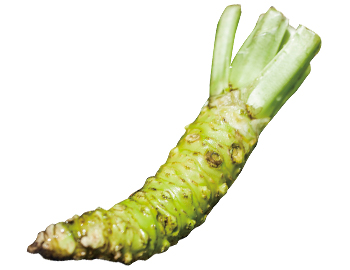
Wasabia japonica, the botanical name for wasabi. As you can see from this, wasabi is a plant native to Japan. It grows naturally in cold, pure mountain streams and other mountain streams, and has been cultivated since ancient times. It goes great with Japanese foods such as soba noodles and sashimi, as well as Western foods such as steak. Research into functional aspects such as antibacterial properties is also being carried out, and global attention is also growing.
The plant is made in Azumino, and is mainly used for raw food, grown in a wild-like environment. It requires a large amount of clean water and a well-permeable sandy soil, which takes time to grow. In other regions, it is a very difficult and unworthy crop, but it is located at the foot of the Northern Alps.Azumino CityThis water and soil were all in high level. The topography is a complex fan-shaped complex that is unique nationwide and drains well, with 700,000 tons of underground water flowing everywhere every day. The source of this water is the melting snow from the Northern Alps, and it passes underground and is not affected by the outside temperature, so it will not exceed 15 degrees even in the middle of summer.
Wasabi began to be made in Azumino from the late Meiji period to the Taisho period. When wasabi was planted in a waterway for a field, it seems that high-quality wasabi has grown, which has led to widespread cultivation in the local area. In order to make the most of the wasabi fields in Azumino, they were actually made by digging into the ground to make the most of the water and soil. The scenery of wasabi fields spreading throughout the city is also an agricultural heritage built up by our ancestors over a longer period than the pioneering spirit.
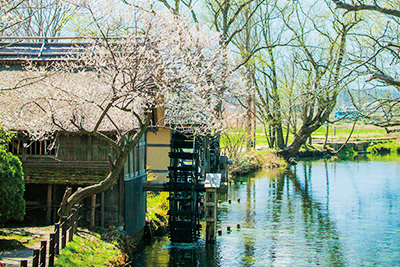
Daio Wasabi Farm, Japan's largest wasabi farm, is known as a major tourist farm that attracts 1.2 million tourists a year.
Azumino CityHe was certified as "Water Village" and was also selected as one of the "100 Famous Waters." In the general election for the "100 Famous Waters" held by the Ministry of the Environment, the Azumino Wasabida Spring Water Group was rated the number one in Japan in two categories: "tourist spots" and "landscapes."
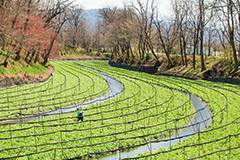
The melted snow from the Northern Alps passes underground through leaf mold, slowly absorbing nutrients, and over the course of many years it springs up on the ground.Azumino CityIn this area, wasabi is cultivated using an unusual method called the flat ground, where underground water is erected and grown in flat areas, creating rows, and is harvested year-round.
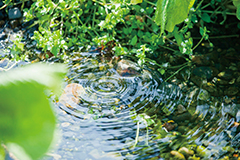
Azumino CityThere are many mysterious rivers, such as the Karasu River, which is sourced from the Northern Alps, where running water is almost invisible once the water reaches the plains. Once the water has flooded underground, it appears as springs on even lower land.
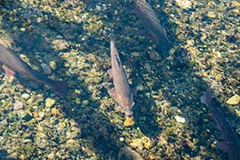
The water used for cultivation of wasabi is rainbow trout, a specialty of Azumino.ShinshuIt is reused in salmon farms. This is because all local producers carry out strict pesticide management.
Wasabi flowers, the seasonal flavor that announces spring to wasabi fields
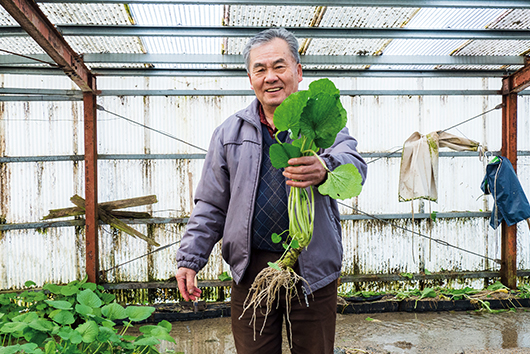
大西渡辺わさび店
Representative Watanabe Kyoyoshi
About 40 years ago, the Onishi Watanabe Wasabi branch, which is located in front of JR Hodaka Station, was the first to introduce facility (house) cultivation in Azumino.
" Wasabi is sensitive to direct sunlight, so if you grow it in an open-air area, you will need to cover it with a black curtain called cheesecloth from early summer to autumn, but it saves you the trouble and you can harvest it easily even in cold seasons. The water and soil are the same as those grown in alleys, so there is little difference in taste. However, it can be exposed to cold weather.TimesBecause there are fewer of these, it takes longer to train them than in the open-air area," says Watanabe. By managing the wasabi growth cycle, which flower in spring, grows in the leaves and stems, grow again in the summer and fall, causing rhizomes (potatoes) to grow, and in winter, it stops growing and becomes more spicy, allowing for a stable supply throughout the year.
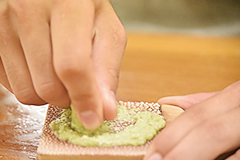
"There are a variety of genuine wasabi products, but freshly grated ones are exceptional. You can feel the sweetness and mellowness in the spiciness."
The aftertaste is also refreshing, and the spicy taste of the tongue is not left behind.
Wasabi is not only edible with potatoes, but also flower buds and leaves, and among them, wasabi flowers are particularly popular as a spring tradition. Infrastructure cultivation, it is a rare ingredient that is circulated mainly by locals, from January to mid-March to early April. The stems when they are in bloom are soft and flavorful, and are delicious when eaten with wasabi boiled. Freshly made it has a strong bitterness, but it also makes it spicy and delicious after a while, which is interesting.
"Maybe due to the effects of less snowfall due to global warming, the amount of spring water has been decreasing in recent years, and the growth of wasabi has also been affecting the growth of wasabi. Rich water is not just for wasabi farmers, but is a valuable resource for the entire region. Of course, we, the local community, must work together to seriously manage resource management," says Watanabe.
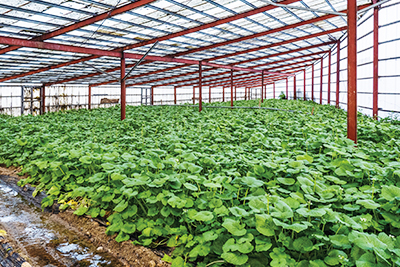
Watanabe's facility cultivation was built on a field where he originally cultivated open-air. The amount of spring water varies depending on the location of the field and the season, so the water volume and temperature are maintained by a mechanism that circulates the water that has gushed out.
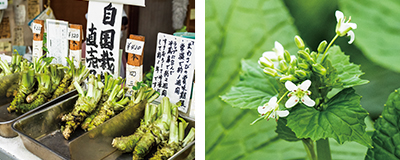
The real wasabi and wasabi flowers from Onishi Watanabe Wasabi store are Ginza NAGANO But for sale. Flowers are special tastes for a limited time only, so don't miss out.
[Onishi Watanabe Wasabi Store]
Azumino CityHotaka 5950-1 TEL 0263-82-5132
INFORMATION
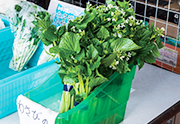
Ginza NAGANO Now on sale! (Until late March)
Rub the wasabi flowers and stems well with salt and leave for a while, then pour in sugar and hot water to soak them. The unique bitterness changes into spicy and deliciousness.
More wider and more people can enjoy the deliciousness of Azumino wasabi.
Marui Co., Ltd.
Kitahara Takashi, Research and Planning and Development Office
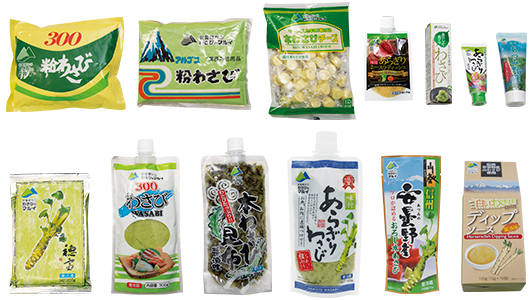
Tube-type kneaded wasabi is an essential part of your daily dining table. Founded in Azumino in 1946, Marui is one of the major manufacturers of wasabi processing, which also handles tube types. Taking advantage of our unique product development capabilities, we manufacture a variety of products, including kneaded wasabi that can be stored at room temperature and fresh wasabi that is refrigerated. One of the most popular products is "Seasoned Aragiri Wasabi." It features a crunchy texture, made from 5mm cut genuine wasabi stems. As the soy sauce flavored version goes well with meat, it seems that there has been an increasing number of inquiries from overseas, including the United States.
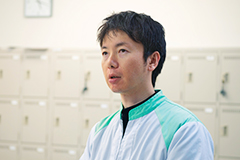
"There are many wasabi products out there, but what we are particular about is the aroma and taste of wasabi. Even when you eat them in restaurants, you can understand what we have," says Kitahara, one of the developers. At the company, employees who have obtained their in-house sensory inspector qualifications after undergoing taste training and taste testing check products made with the raw materials of wasabi potatoes and stems, as well as salt and seasonings. We also measure pH and salt concentration each time, check the condition of the kneading and taste it to ensure a high standard of quality and safety.
Also, recently, until the 1960s.Azumino CityHowever, we are also working on reviving the horseradish that was being made. One of them, the new product, "White Wasabi Dipping Sauce," is wasabi specialised in soaking it on meat, and Kitahara says he has been developing it with a particular focus on the aroma.
"This product was a product that was designed with souvenirs in mind, including packaging. I hope that we can make new specialty products made with horseradish and contribute to the local area."
As a pioneer in local wasabi processing manufacturers, we are also taking on the challenge of creating products that look at the next era.
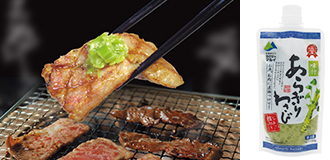
"Seasoned Aragiri Wasabi" is said to go well with meat
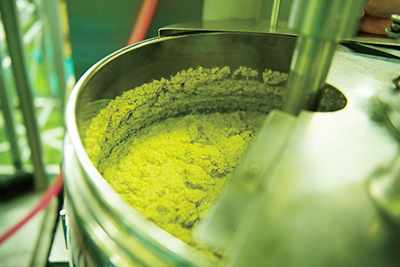
わさびは芋や茎を砕いて塩などを加え、辛味が飛ばないよう短TimesIt will be processed with. Let it sit for more than 10 hours to activate it (change the bitterness of wasabi into spicy). The photo shows the paste-like wasabi that has undergone activation and before filling.
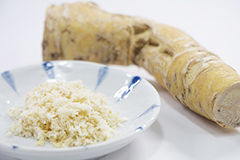
The blender monitors check the taste and condition immediately after blending and revitalizing and quality control, and Kitahara also determines the ingredients blending rate when developing the product. Horseradish is also generally eaten grated.
[Marui Co., Ltd.]
Azumino CityToyoshina 4932 TEL 0263-72-2562
https://www.wasabi.co.jp/
INFORMATION
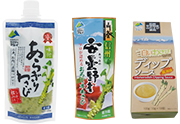
Ginza NAGANO Now on sale!
The popular product, "Fished Aragiri Wasabi," has a variety of uses, including ingredients for yakiniku, pasta, and sandwiches. "Grilled Azumino Wasabi" is a dish that is popular with craftsmen, using only genuine Azumino wasabi. "White Wasabi Dipping Sauce" is a soy sauce-based sauce that can be stored at room temperature and is scheduled to be sold on March 21st.
Making delicious and safe pickles that makes use of local resources and environment
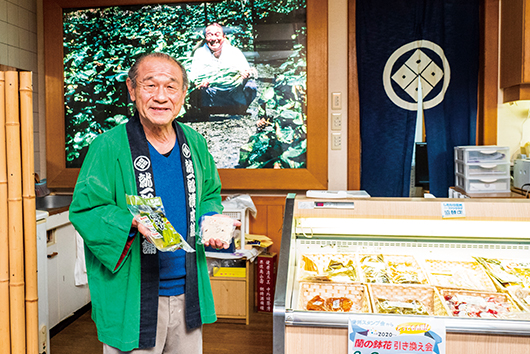
Tsuruichirozuke Honpo
Chairman Kamijo Kazuo
Wasabi pickles are perfect for the spicy wasabi and the richness of sake lees. There are many sake breweries in the Matsumoto and Azumino region, and since it was easy to obtain high-quality sake lees, many wasabi farmers made wasabi pickles. Its characteristic is the material. Most of the commercially available Wasabi pickles use stems, but Azumino's Wasabi pickles are chopped and marinated in the potatoes.
"Tsukuichiro Pickles Honpo" is also a pickle manufacturer that is rooted in the local community and is particular about using a careful manufacturing method. Initially, he wasabi and sold daily necessities, but the second generation, current chairman, Kamijo, decided to run the business with just one pickle, and founded the "Tsuichiro Pake Honpo" named after his father. Special Wasabi Pickles, made from sake lees that have been placed in barrels or buckets and laid for about half a month to add to its delicious taste, are a proud dish that won the Minister of Agriculture, Forestry and Fisheries Award at a specialist product competition in 2003.
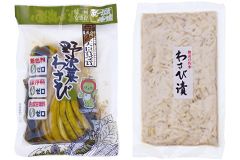
Another main product is Nagano Pickled Nozawana, a specialty of the prefecture. The characteristic of this product is that it is not lightly pickled (overnight pickled), but is made from "hon-pickled" which has been pickled for about two weeks and fermented lactic acid bacteria.
「 Nagano Just as people who came to the prefecture and ate Nozawana, they all said that the authentic taste was delicious. That's because we eat pickled Nozawana, which has been properly fermented with lactic acid bacteria."
Kamijo said this, and made use of the techniques of pickled Nozawana and the wasabi from Azumino, the popular product, "Nozawana wasabi." The spicy and aroma unique to fresh genuine wasabi won the Minister of Agriculture, Forestry and Fisheries Award at the first Reiwa competition.
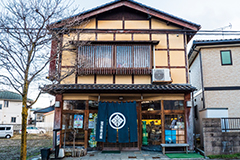
"Nozawana wasabi is a product that was born because I am in Azumino. I would like to continue to create products from the perspective of "making it with the help of nature," which is what delicious food is, and what are things that can be safe and healthy."
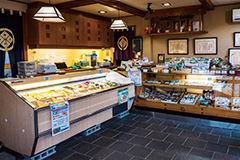
Kamijo isAzumino CityThe company has launched the "Hotaka Wasabi Youth Association (now Azumino Wasabi Youth Association)" with a focus on retailers and producers in the country. Nagano He served as the first president of the Prefectural Product Promotion Association. Nagano We have focused on promoting the prefecture's products and branding Azumino wasabi. As a result, Azumino wasabi, which has a spicy taste and taste that is different from Shizuoka's wasabi, gradually spreading throughout the country.
"The time for Nozawana will come," Kamijo said, and took over the family business and soon began producing Nozawana pickles. "Nozawana wasabi" is made by adding pure pickled Nozawana to a soaked liquid made using genuine wasabi, then soaking it for another 3-4 days, and is less salty.
[Tsukuichirozuke Honpo Main Store]
Azumino CityToyoshina Minamihotaka 473-2 TEL 0263-72-5311
https://www.shinshu-nozawana.co.jp/
INFORMATION
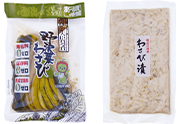
Ginza NAGANO Now on sale!

"Genuine wasabi" and "Horsewabi"
Honka wasabi is made from wasabi native to Japan. There is "Sawa wasabi" and "Hata wasabi" that is grown in fields, and the "Hata wasabi" is mainly eaten by potatoes and the leaves and stems of the wasabi. "Horsabi" native to Europe is mainly used as a raw material for kneaded wasabi. 「生わさび」はわさびをすりおろしたもののことを指します。
How to grate genuine wasabi
Wash clean with water to remove any blackened areas. If you want to make it spicy, try using as finely as grated shark skin. If not, you can tap it with the back of a knife or something similar. The finer the flavor and spicy taste become stronger, and the antibacterial properties become more effective. Also, if you place a small amount of sugar on a grater and grate it, the wasabi scatholic (bitterness) will disappear, bringing out the aroma and spicy taste even more.
How to save
If you want to store it without shaving it, wrap it in wet newspaper or kitchen paper, then wrap it in plastic wrap and place it in the fridge for about two weeks. If you want to grate it, remove it all at once. Wrap it tightly in plastic wrap and freeze it for a long time.
This article is information as of March 2020.
Please note that the products we carry may have changed.